

W.Minh Tuan
I have said that Singapore is not the happiest country in the world. In 2022, the happiness level of Singaporeans was only rank about 20th in the world.
However, Vietnam is ranked about 76th, so if I say that Vietnam should learn from Singapore’s development, it wouldn’t be strange.
When Vietnam will stand above Singapore, for example, Vietnam ranks 15th, then it should be said that Singapore should learn from Vietnam.
But until then it will probably be many years away.
So now, if I say that Vietnam should learn from Singapore, you probably won’t object.
If you go to Singapore, when the plane is about to land at Changi airport, look down from the plane window and see the Singapore sea, ships parked crowded like bamboo leaves, waiting to dock at Singapore port. On the Malaysian side of the sea, ships are scattered like few leaves left in winter.
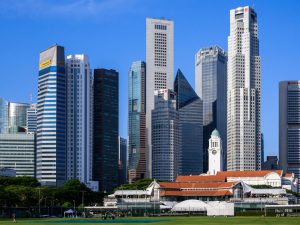
When the plane lands lower, you will see that on the Singapore side is a forest of high-rise buildings rising to the blue sky, a society filled with life, dynamism, and development.
As for Malaysia, we only see flat, patchy wasteland, with life only sporadically present.
The reason for that contrast lies in the way the country is led, managed.
Singapore has an area of just over 700 square kilometers, a little larger than the old city of Hanoi in Vietnam.
Every year, they fill soil in to the sea, so today, Singapore’s area is a little larger than 1000 square kilometers.
And compared to the current expanded Hanoi, with an area of 3,328 km2, Singapore is only 1/3 as large as Hanoi. Hanoi’s current population is more than 7 million people, Singapore’s population is more than 5 million people.
Singapore has a length of more than 40 km one way and more than 30 km one way. Equal to the distance from Hanoi center to Noi Bai airport.
Yet they have one of the world’s leading development indexes.
In 2022, Singapore’s GDP is more than 400 billion USD, per capita income is nearly 60,000 USD.
Foreign investment capital FDI into Vietnam in recent years has averaged about 10 billion USD each year.
It is also very exciting.
But compared to small Singapore, Vietnam with 90 million people is still far behind Singapore with 5 million people.
30 years of innovation attracted foreign FDI investment into Vietnam, from 1986 to 2022, totaling about 300 billion USD.
As for Singapore, in 2016 alone, they attracted more than 240 billion USD.
In 2011, they attracted 52 billion USD, in 2012: 84 billion USD, in 2013: 107 billion USD, in 2014: 156 billion USD, in 2015: 211 billion USD, 2016: 240 billion USD.
The difference is only in the way of leading the country.
Singapore has been a British colony since 1826. In 1946, Singapore gained independent status, but remained within the British Union.
In 1954, Mr. Lee Kuan Yew, a young lawyer who graduated from England, participated in founding the People’s Action Party (PAP: People’s Action Party) of Singapore.
And only 5 years after its birth, Mr. Lee Kuan Yew’s PAP party won the election. In 1959, Mr. Lee Kuan Yew – General Secretary of the PAP party became the first Singaporean Prime Minister of independent Singapore within the British Union.
At that time, lawyer Lee Kuan Yew was only 36 years old.
In 1963, Singapore joined the Federation of Malaysia, but only 2 years later, in 1965, it separated into an independent country.
Mr. Lee Kuan Yew, General Secretary of the PAP Party, was Prime Minister of Singapore for 31 years, from 1959 to 1990.
Despite being in power for so long, no Singaporean calls Mr. Lee Kuan Yew a dictator. Because Mr. Lee Kuan Yew does not rule by suppressing opposition parties, but by the trust of the Singaporean people.
In 1990, when he was 77 years old, Mr. Lee Kuan Yew asked the people of Singapore to give him a break because of his old age and weak health.
He only applied to be a Minister advising the Government.
Mr. Lee Kuan Yew’s PAP Party has led Singapore since gaining independence from the British in 1959 until now, just as the Communist Party of Vietnam has led the Vietnamese people since gaining independence from the French in 1945 to present.
Respect talented people
The first experience that can be seen is that Mr. Lee Kuan Yew’s PAP party gathered many talented and highly educated people.
As a leader, you need to have many talented people to help you. Without talent, you cannot lead. That is Mr. Lee Kuan Yew’s opinion.
General Secretary Lee Kuan Yew himself graduated in law from two prestigious universities, Cambridge University and Fitzwilliam College in England in 1949, when he was 26 years old.
The second General Secretary of the PAP party, and also the second Prime Minister of Singapore, from 1990 to 2004, was Mr. Goh Chok Tong, who graduated from the prestigious Williams College, USA, majoring in Economic development.
The third General Secretary of the PAP party, the current third Prime Minister of Singapore, Mr. Lee Hsien Loong, is the eldest son of Mr. Lee Kuan Yew, born in 1952, and also graduated from Cambridge University in England in mathematics and computers.
After that, Mr. Lee Hsien Loong also studied Public Administration at Harvard University – USA.
Singapore’s parliamentarians are from the PAP party and the ministers are also from the PAP party, and all graduated from famous universities in the world.
Deputy Prime Minister Jayakumar, a member of the PAP party, in charge of national security, graduated from the Faculty of Law, Yale Law University, USA. This is the university where US President Bill Clinton, and his wife Hillary Clinton studied.
Minister of Foreign Affairs George Yong-Boon Yeo, a member of the PAP party, was born in 1954 and also graduated from Cambridge University in England.
Mr. Minister, Chief of Cabinet Secretary Lim Swee Say, born in 1954, member of the PAP party, graduated from Loughborough School in England.
Minister of Defense Teo Chee Hean, born in 1954, graduated from Imperial College London – England.
The views of the Party General Secretary and Prime Minister Lee Kuan Yew on respecting and attracting talented people have been thoroughly and very effectively implemented by the PAP party.
“Bad leaders will chase away good and talented people, not allowing them to hold important positions,” Mr. Lee Kuan Yew said.
Singapore not only finds and uses talented people among Singapore citizens, but also attracts talented people from other countries.
In 1997, when Mr. Lee Kuan Yew resigned as Prime Minister of Singapore and became Minister of Government Counsel, he proposed that the Singapore Government recruit a series of American, and British experts to work in government agencies, and in Singapore government.
Singapore speaks English, so this recruitment is not difficult.
In 1998, Singapore’s DBS Development Bank invited Mr. John Olds, an American, a senior official of the US financial-banking corporation J.P.Morgan, to be Vice Chairman of DBS.
Soon after, Singapore’s Overseas Chinese Banking Company-OCBC also invited Mr. Alex Au, a famous Hong Kong banker, to become OCBC’s leader.
These two leading experts in finance and banking have helped Singapore become the 4th largest financial center in the world, after the US, London, and Tokyo.
Talented foreigners come to Singapore to work, settle permanently, and easily gain Singapore citizenship.
The PAP Party directly leads the country
The second experience is that people from Mr. Lee Kuan Yew’s People’s Action Party (PAP) directly hold leadership positions in the country.
The Party General Secretary always directly holds the position of Prime Minister.
Senior party members hold ministerial positions. Since then, the PAP party’s policy has been implemented directly through party members holding state leadership positions.
In Vietnam, we have the view that the Party does not replace the government. It seems good, but in fact it is wrong.
If the Party does not directly control the government, it only leads on clouds and wind.
In Vietnam, we have separately General Secretary, State President, Provincial Party Secretary, Provincial Chairman, that is very wrong.
The General Secretary must also hold the position of President, becoming like the President.
The Secretary of the Provincial Party Committee or City Party Committee must concurrently hold the position of Chairman of the Province or City, in order to become Provincial Governor or Mayor. Only then will the leadership be direct, not bureaucratic, and there will be no conflicts or quarrels between the Secretary and the Chairman.
Comrade General Secretary Nguyen Phu Trong once served as President and led national affairs very smoothly.
One day, our country of Vietnam should fix and not change the position of General Secretary and President, and move towards the merger of Secretary and President in localities, for the benefit of the nation, for the sake of strength of the country of Vietnam, not for anyone’s personal benefit.
English is the national language, along with Chinese
The third experience to develop Singapore is English training, making English the official language, along with Chinese.
Mr. Lee Kuan Yew led the PAP party to gain independence for the people of Singapore from the British, abandoning British leadership, but he did not abandon English language.
And even the administrative apparatus that the British built in Singapore during more than 100 years of colonial rule, Singapore did not abolish. Mr. Lee Kuan Yew absorbed all of that advanced administrative system. People are free to reside, and private property rights are not abolished.
In Vietnam, after gaining independence from the French, we also abandoned French, which was a waste.
Language is a tool for national development, language does not harm the country’s independence.
And the advanced, scientific, bureaucratic management methods developed by the French in our country are no longer applied.
Now, Vietnam has to send people to France to learn French, which is very expensive.
Then we also sent many delegations to France to learn advanced French administrative management methods, which the French had previously applied to Vietnam.
Regarding the importance of English, Mr. Lee Kuan Yew said: “Mastering English is the key to gaining knowledge and high technology from the West.”
If our country Vietnam, after gaining independence from the French, did not abandon French language, and still kept French language to develop alongside Vietnamese language, then Vietnam’s education, culture, economy, science and technology would probably be much more developed than we are now.
Low taxes.
Singapore has one of the lowest tax rates in the world, like Tax Haven. Please do not confuse the word Haven – a peaceful place, a peaceful residence, shelter, refuge – with the word Heaven.
Of course, a place of peace, place of safety has a meaning that is not very different from Heaven, because Heaven is the most peaceful place of residence and refuge.
The pronunciation of these two words is also close alike.
Singapore’s taxes account for only 17% of GDP, among the lowest in the world.
In Vietnam, taxes account for 24% of GDP. But if excluding non-tax revenues, such as revenues from oil and gas, Vietnam’s taxes account for more than 30% of GDP, among the countries with the highest tax rates in the world.
After leaving the EU, Britain also decided to gradually reduce taxes.
Currently, the UK has a low tax rate of 17% like Singapore.
US President Trump also had a plan to reduce taxes from over 35% currently, to 20%, and eventually to 15%.
But Mr. Trump lost the presidency to Mr. Biden in 2020, so this US tax reduction plan has not been implemented.
Mr. Lee Kuan Yew abolished the inheritance tax, because he believed that the inheritance that parents and grandparents leave for their children and grandchildren is a moral issue and should not be taxed.
Singapore’s income tax is also among the lowest in the world, because Mr. Lee Kuan Yew wants to encourage people to get rich.
In Vietnam, income tax starts at 5%. People with income from over 80 million VND/month are subject to 35% income tax.
In Singapore, people with an income of 20,000 Singapore dollars (about 17,000 USD) do not have to pay income tax.
People with income of 30,000 Singapore dollars (about 27,000 US dollars) must pay 2% income tax. And the highest income tax increase is 20%, applicable to people with income of 320,00 Singapore dollars, or about 270,000 US dollars.
Direct taxes, levied on the income of people and companies, from accounting for 2/3 of the Singapore State budget, gradually decreased to ½ of the current budget.
Singapore does not tax profits from stock investments, like Switzerland, Luxembourg,,,,.
Import tax is only about 0.4%, VAT is only 3%.
Property tax – is a tax on home and land ownership, from 60%, reduced to 5% currently.
This level is still quite high, because Singapore is a small country. In Switzerland-Switzerland, real estate ownership tax is only 0.3%-0.5%.
Both Singapore and Switzerland do not tax when buying and selling real estate, only taxing real estate ownership.
In Vietnam, we do not have a real estate ownership tax, but there is a 10% real estate purchase and sale tax.
For FDI foreign investment companies investing in Singapore, first, the Singapore Government grants tax exemption for 5 years.
But from 1970 until now, tax exemption has been granted for 10 years.
Every Singaporean owns a cheap house built by the State and sold cheaply to the people.
Singapore Prime Minister Lee Kuan Yew said that he wants Singapore to be a country where every Singaporean family can own their own house or apartment, not a rented house.
Because Mr. Lee Kuan Yew believes that if people can own houses and apartments, they will have a higher sense of responsibility, higher patriotism, and a more enthusiastic and creative working spirit.
With the very idea of Government of the people, by the people, for the people, in 1960, Mr. Lee Kuan Yew established the HDB-Housing Development Board, under the Ministry of National Development. This ministry is responsible for building low-cost houses to sell to Singaporeans.
Foreigners are also allowed to buy houses and apartments in Singapore, with an ownership period of 100 years.
In 1967, the first year, HDB built 3,000 low-cost houses. By 2022, a total of more than 1.2 million luxury apartments has been built, and houses, apatments has been sold to more than 5 million Singaporeans, and also sold to foreigners.
Many Vietnamese people have bought and owned houses in Singapore, pay off debt, installment period within 20 years.
Try to imagine a tiny country like Singapore, where they dare to set the goal of “each family owning a home”.
It’s amazing.
Although land in Singapore is more expensive than gold, because the country’s area is only 1/5 of Hanoi’s, the average income per capita is 30 times higher than Vietnam’s, yet a modern apartment with an area of 60 m2 costs only 150,000 USD, price of luxury apartments 150 m2, 200 m2,,, and larger, price only 450,000 USD.
The price of luxury apartments in Singapore is cheaper than the price of houses and apartments in the center of Hanoi and Saigon today.
So far, in 2022, 90% of Singaporean families already own a modern apartment, or a spacious house of about 150 m2.
I visited the home of a Singaporean family of 4, living in a vast apartment of 150 m2, 3 bathrooms, paying off the debt after 12 years, because all 4 people work and have salaries.
No country in the world has done that.
Next to large apartment buildings, Mr. Lee Kuan Yew built clean technology industrial parks, and invited foreign companies to invest, build factories, and receive 10-year tax exemption.
The world’s leading companies have built factories in these clean industrial parks, such as Hewlett-Packard, Compaq, Texas Instruments, Apple Computer, Hitachi, Mitsubishi,,,.
These clean industrial parks recruit workers from apartments living right next to the industrial park.
250,000 people living in these apartments have found jobs from the above clean technology factories.
The state is democratic and respects the people
Singapore’s fifth experience is building a democratic state that respects the people.
Mr. Lee Kuan Yew said, “If we do not work hard, then when the people lose faith, the blame will be ours. When people have lost all confidence, they will demand it a different kind of Government“.
Mr. Lee Kuan Yew said that people do not care much about institutions and forms of Government, but they care about “having a Government established through elections, they have the ability to elect their Government.“, and the Government will bring a better life to them and to their future descendants…”.
Fight corruption with strict laws and fair wages
The sixth experience is resolutely fighting corruption.
“Singapore’s survival depends entirely on the integrity and performance of its ministers and senior Government officials,” Mr. Lee Kuan Yew said.
He repeatedly affirmed that “the people absolutely cannot tolerate speculators and scoundrels“.
Regarding the purity of the state apparatus, in 2015, Singapore was ranked 1st, the cleanest in the world. Currently, in 2022, also ranked 1st.
Prime Minister Lee Kuan Yew is a former lawyer and graduated in the UK, so he understands the law very well. He applied a very strict anti-corruption legal system.
At the same time, he said that if you want to fight corruption well and attract talented people, you must pay a worthy salary.
In 1985, Mr. Lee Kuan Yew said that Singapore had 676 rich- businese people whose income was higher than the salaries of Ministers.
But the three ministers of Finance, Defense, and Housing play a more important role for Singapore than the other 676 high-income private company directors.
And the salary paid to the entire Singapore Government apparatus in 1985 was just over 2.5 million US dollars.
While that Government apparatus manages a country with a GDP of 17 billion US dollars (1985).
The Singapore Shipping Company only makes more than 1 billion US dollars in revenue, but the salary of that company’s senior leaders is nearly 2 million US dollars.
Mr. Lee Kuan Yew compared Singapore to a business. And no matter how many billions of dollars a Singapore “business” makes annually, the salary of the leader of a “Singapore business” must be equivalent to that “sales”.
Since then, Mr. Lee Kuan Yew has determined to increase salaries for key positions leading the country.
Currently, the salaries of Singapore’s Ministers and Prime Ministers are among the highest in the world. The salary of Singapore Prime Minister Lee Hsien Loong – son of Mr. Lee Kuan Yew, in 2015 was about 1.2 million dollars a year, 3 times higher than the salary of the US President, 2 times higher than the salary of the Australian Prime Minister.
The salary of Ministers is about 800,000 USD a year. The salary of a Singaporean Minister is about 4 times higher than the salary of a Minister in the US.
In Vietnam, our Kilo submarine sailors have a salary of 2,500 USD/month.
So good.
Our country is still poor, but the State dares to pay such high salaries to submarine sailors, to ensure that the soldiers can rest assured to serve the country and protect the Fatherland, which is very right.
The salaries of senior Vietnamese officials should also learn from Singapore’s methods, to ensure an honest state apparatus like Singapore.
If Ministers, Prime Ministers, National Assembly Delegates, Party Central Committee members, Politburo members, etc. of Vietnam have a salary of around 30,000 USD/month, about 600 million VND/month, surely Vietnam Our country will have a clean, luxurious, civilized, and more effective State apparatus, attracting more talented people.
Our Vietnamese government should allow the people to discuss and collect people’s opinions on the salaries of leading cadres, which will certainly receive people’s support.
Caning punishment.
The country of Singhapore has caning to punish those who destroy public and private property and assault others.
Our country in Vietnam should learn from this caning punishment, applied to those who fight, post pictures online, and other violent criminals in the family, husbands abuse their wives, children abuse their parents.
Singapore is also very strict with violations of littering, chewing gum thrown on the street, smoking in places where smoking is prohibited,,,. All were fined 500 Singapore dollars, about more than 400 US dollars.
Of course, punishing too harshly is also counterproductive, causing Singaporeans to be criticized, stressed, tension, not much relax, so in terms of people’s happiness, Singapore is only ranked 20th in the world, not the top in the world.
We Viet Nam should not learn from Singapore this too strict law and rule.///